
Agentic AI development services
Enable autonomous execution across critical business workflows with Agentic AI
When execution breaks across handoffs, isolated AI features do not fix the workflow. WebNetNode redesigns high-value workflows for agent ownership, builds the multi-agent systems that run them, and scales with the AgentOps discipline required in production.
I'd Like To Know More!
Move beyond experimental to governed, production‑grade agentic AI
As a Microsoft Solutions Partner for Data & AI, WebNetNode brings the cloud, data, AI, and governance rigor required to build agentic AI systems on real enterprise foundations. With proprietary accelerators such as ThoughtMesh, we bring reusable patterns for multi-agent orchestration, RAG-based enterprise knowledge grounding, LLM integration, human-in-the-loop controls, and governed, monitored deployment, helping teams move from isolated pilots to production-grade agentic workflows faster.

Agentic workflow transformation
Workflows that stall across fragmented ownership and manual decision points need to be restructured so execution can move continuously with clear accountability and measurable outcomes. We run a process intelligence audit to identify where delays, rework, and decision bottlenecks occur, redesign workflows around agent ownership and human intervention boundaries, and define transformation roadmaps tied to cycle time reduction, throughput improvement, and error minimization.
Agentic readiness assessment and process intelligence audit Use case scoring and value prioritization framework Task decomposition and agent-first workflow redesign Human-in-the-loop boundary design and escalation paths Phased transformation roadmap with KPI and ROI benchmarks
Multi-agent design & orchestration
Reliable autonomous execution depends on how agents coordinate, integrate with systems, and manage state across steps. We design multi-agent orchestration architectures while also engineering the runtime layers, integration patterns, and execution models required to run these systems reliably. This is accelerated through our ThoughtMesh accelerator which brings pre-built orchestration patterns, policy enforcement, and integration layers that help reduce time-to-value.
Agent role definition and capability boundary design Orchestration pattern selection and sequencing logic Agent runtime architecture across systems Tool and LLM integration specifications across enterprise systems Deployed multi-agent system on target platform
Enterprise knowledge & context engineering
Agents without consistent, secure, and validated access to business context create conflicting decisions, increase rework, and fail to maintain trust in execution. We design RAG-based retrieval and grounding architectures that ensure agents operate on reliable context, build persistent memory across workflows, and enforce identity-aware access so every decision is both accurate and compliant with enterprise data boundaries
Retrieval and grounding architecture design Semantic memory and context persistence across workflows Identity-aware data access and role-based context control Secure enterprise data integration with across systems Context validation frameworks and decision consistency testing
Agent lifecycle management
Agentic systems degrade quickly without continuous visibility into performance, cost, and decision quality as workflows evolve and scale. We establish the governance and monitoring framework covering how agents are versioned, evaluated, updated, and retired, alongside AgentOps tooling and responsible AI governance so every agent in production stays aligned, auditable, and cost-efficient.
Agent versioning and update governance framework Evaluation pipelines for task success and workflow KPIs Cost monitoring, optimization strategies, and budget enforcement Responsible AI controls and compliance documentation Deprecation and agent retirement protocols
Agent CoE, industrialization, and platform engineering
Orgs move from one off pilots to an AI factory when there is a central CoE and a shared platform that standardizes how agents are built, run, and scaled. We design and stand up that CoE, define delivery and ownership models, and architect the agent platform that provides common runtime, tooling, and guardrails across teams. This helps industrialize agentic AI, so new agents plug into the same patterns instead of starting from scratch every time.
Centre of Excellence charter and operating model Agent pod structure, responsibilities, and delivery governance Shared agent platform with reusable components and patterns Agent managed services for continuous monitoring, incident response, and optimization Common processes for intake, lifecycle management, and scaled rollout
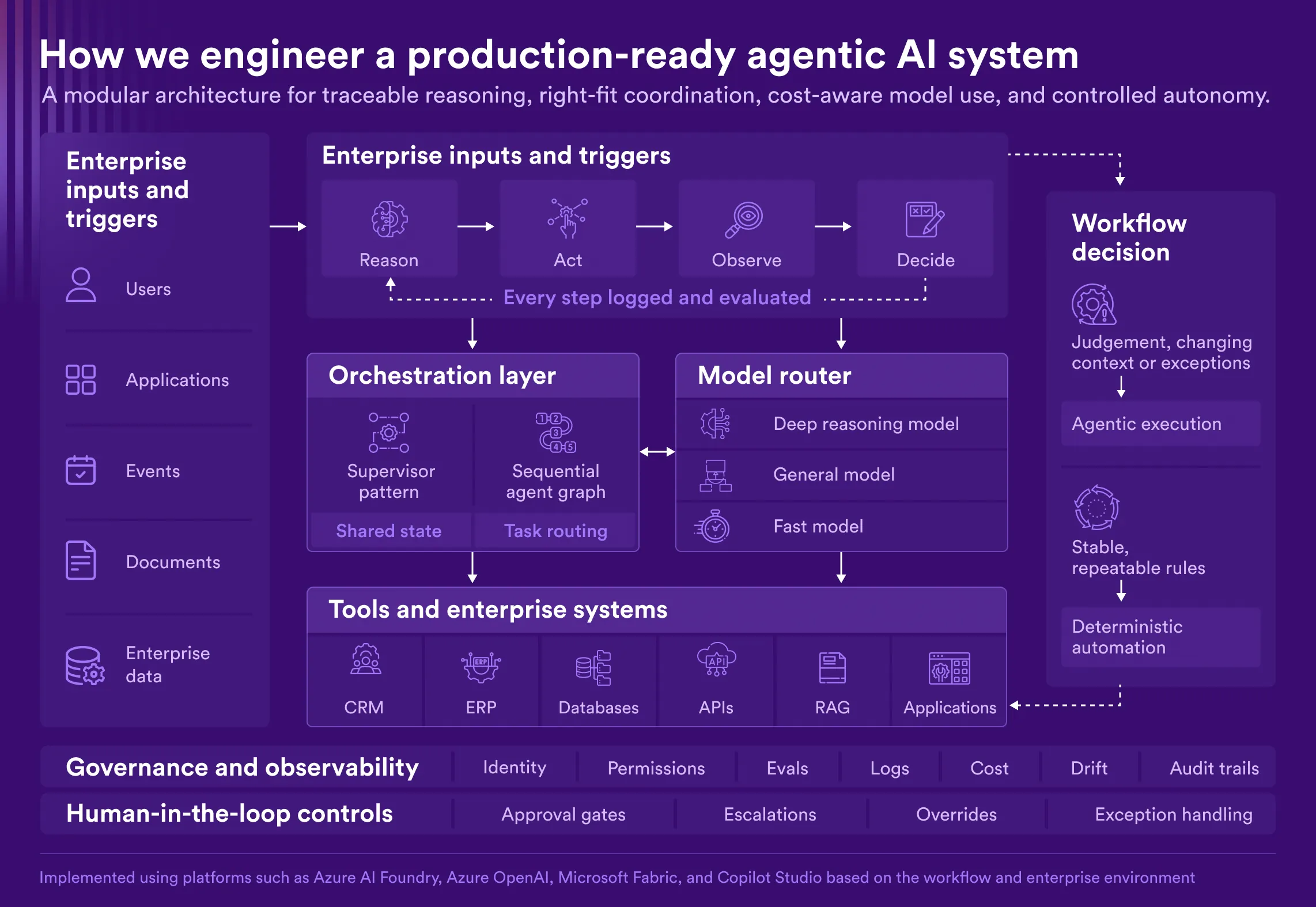
How we engineer an agentic AI system
Production-ready agents depend on early architectural decisions. We design for traceable reasoning, efficient coordination, cost-aware model use, and clear boundaries between agentic and deterministic automation.
1. Traceable reasoning loops
Agents follow a ReAct-style loop: assess the task, call the right tool, interpret the result, and choose the next step. Each action and its rationale are logged, creating a clear audit trail for debugging, governance, and review.
2. Coordination matched to the workflow
Parallel work uses a supervisor agent that delegates to specialists and combines their outputs. Dependent work uses sequential agent graphs with shared state. We select the pattern based on task structure so orchestration remains efficient and manageable.
3. Right-fit models for each task
Agents access models through a routing layer. Complex reasoning goes to more capable models, while classification and extraction use faster, lower-cost options. Model selection happens at the task level to balance quality, latency, and cost.
4. Clear boundaries for agent use
Stable, rule-based steps remain deterministic because they are cheaper and more reliable. We use agents where work requires judgment, changing context, or exception handling, and define that boundary before the architecture is finalized.
A commercial HVAC services company reduced reporting time by 80% using AI-powered field agents.
Field teams ran job data, billing, and reporting through manual, paper-heavy steps that delayed every job close. WebNetNode built a mobile-first operations platform with Azure AI Foundry agents handling field data capture, billing, and report generation.
A global strategy consultancy reduced qualitative analysis time by 80% with an LLM-powered platform.
Consultants spent days reviewing interview transcripts and research inputs for each client engagement. WebNetNode built an LLM-powered platform that structures and analyzes that qualitative research automatically.
A research platform delivers reliable, context-aware retrieval to more than 150,000 users.
A large user base needed fast, accurate answers across a deep body of source material. WebNetNode engineered a GenAI cognitive search layer that returns context-aware results from the corpus.
Use cases we cater to with our Agentic AI services

Trusted by the World's Leading Companies











Frequently Asked Questions
RPA follows fixed rules, generative AI and copilots respond to prompts, and chatbots answer within set flows. Agentic systems reason, plan multi-step work, use tools, and act toward an outcome under human oversight. WebNetNode scopes each engagement around real autonomy, defining where an agent decides, where it acts on your systems, and where a human stays in control before anything reaches production.
Most agentic projects stall without a clear value case, production discipline, or cost control. WebNetNode addresses these gaps by scoring use cases for measurable value and setting KPIs like cycle time and error reduction before any build. We then engineer for production with orchestration, evaluation, and AgentOps. Governance and cost monitoring are built in, so agents stay accurate, auditable, and cost-efficient at scale.
Agents connect to your current and legacy systems as an intelligence layer, so nothing needs to be rebuilt. WebNetNode builds defined integration patterns across CRMs, ERPs, data platforms, and APIs, with identity-aware access that respects your data boundaries. On the Microsoft stack, WebNetNode builds agents on Azure AI Foundry, extends them through Copilot Studio where low-code orchestration fits, and follows Microsoft’s Well-Architected and Responsible AI frameworks for security and governance.
Agentic cost comes mainly from integration, the models and compute behind each agent, and ongoing operation at scale. Costs escalate when agents run without limits or expand beyond their original scope. WebNetNode scopes agents to high-value workflows, monitors spend, and enforces budgets to control the total cost of ownership. We also tune model choice and orchestration so we spend more time on the value agents deliver.
Timelines depend on the workflow, but a focused first use case usually reaches production in a few months. WebNetNode builds that first use case as a repeatable model. To scale, we stand up a shared agent platform and Center of Excellence. New agents reuse proven patterns, runtime, and guardrails instead of starting from scratch. AgentOps keeps them reliable as volume and complexity grow.
You rarely need to fix the entire data layer first. Agents do need reliable, governed access to the context a workflow depends on. WebNetNode assesses data readiness while scoring each use case, then builds the retrieval, grounding, and access controls the workflow requires. Real gaps in quality or governance get fixed along the way, without a full data overhaul.