
Agentic DevSecOps

Bring agentic execution to DevSecOps without compromising control

Shift from rule-based DevSecOps checks to agentic workflows that analyze, act, and verify. As a Microsoft Data and AI Solutions Partner, WebNetNode helps teams bring AI into secure software delivery with policy-bound automation, human oversight, and production-grade control.

Talk to our AI experts
banner image

Agentic DevSecOps capabilities for AI-native, governed, autonomous software delivery

As delivery pipelines move faster, DevSecOps teams need a better way to review changes, resolve risks, and validate releases without slowing execution. WebNetNode helps you redesign DevSecOps with agentic execution, combining deep engineering expertise, proven accelerators, and reference architectures to scale autonomous workflows within clear policy, auditability, and ownership boundaries

Agentic DevSecOps operating model

Move from tool-led automation to an agent-executable DevSecOps model where delivery workflows are designed for autonomous reasoning, controlled action, and human oversight from the start. WebNetNode maps which DevSecOps decisions can be delegated to agents, which require human approval, and which must remain policy-locked. We define the agent roles, decision boundaries, escalation paths, and ownership model needed to make agentic delivery safe at enterprise scale.

Autonomy suitability assessment across DevSecOps workflows Decision rights mapping for agent-led and human-approved actions Escalation, exception, and ownership model design
DevSecOps agent mesh and tool orchestration

Build specialized Dev, Sec, Ops, QA, compliance, and remediation agents to coordinate across repositories, CI/CD systems, cloud platforms, observability data, and release workflows. WebNetNode designs the orchestration layer that governs how agents call tools, pass context, validate each other’s outputs, route exceptions, and trigger approved actions. This creates an agent mesh where delivery tasks are not just automated, but reasoned through, delegated, and executed through policy-bound workflows.

Agent-to-tool invocation logic across CI/CD and cloud systems Context handoff design between dev, sec, ops, and QA agents Cross-agent output verification and exception routing framework
Infrastructure reasoning and IaC autonomy

Turn infrastructure-as-code into a context-aware delivery layer. Agents can review proposed changes, understand the target environment, flag policy conflicts, and suggest safer deployment paths before infrastructure moves forward. WebNetNode enables this across modern IaC and cloud-native environments such as Terraform, Helm, Pulumi, and Kubernetes. Infrastructure changes are assessed for security, reliability, cost impact, compliance fit, and deployment readiness before they reach production.

Drift, dependency, and environment impact assessment Cost, security, and compliance risk evaluation for IaC changes Pre-deployment safety scoring for Terraform, Helm, and Kubernetes
Autonomous security remediation loops

Create closed-loop remediation workflows that move security findings from detection to validated fixes with fewer manual handoffs. Deploy agentic workflows to prioritize risks, suggest remediation paths, verify fixes, and capture evidence for review. WebNetNode designs these workflows so each action follows clear policy boundaries. High-risk changes stay approval-bound, while repeatable low-risk fixes can move through governed autonomous loops.

Security finding triage based on severity, context, and release risk Fix recommendation, patch validation, and approval workflow design Remediation evidence capture for compliance and audit readiness
Agent control plane and delivery intelligence

Maintain visibility and control over how DevSecOps agents behave, decide, and act across secure delivery workflows. WebNetNode implements the control plane for agent access, tool permissions, action logs, decision trails, and continuous policy tuning. This gives engineering, platform, and security leaders the intelligence needed to scale agentic automation without creating opaque, ungoverned, or unauditable delivery systems.

Role-based agent permission mapping across tools and environments Agent action logs, replay trails, and decision traceability design Continuous policy drift detection and exception monitoring

Task-specific AI agents for modern delivery pipelines

Our expanding suite of intelligent, purpose-built agents brings both speed and control to cloud-native and AI-native delivery by reducing pre-commit risk, validating infrastructure, architecture posture, and strengthening release confidence.

IaC generator agent

Produces infrastructure-as-code drafts for cloud resources, environments, and deployment configurations. It helps teams accelerate provisioning while keeping infrastructure changes structured and reviewable.

WAFR agent

Evaluates workloads against well-architected principles, highlighting gaps in reliability, security, cost, performance, and operational design before they become production issues.

Security evaluation agent

Assesses code, configurations, dependencies, and pipeline changes against defined security expectations, helping teams identify risks earlier and prioritize what needs remediation.

LLM + ML Ops agent

Supports model lifecycle tasks such as model selection, version tracking, deployment readiness, monitoring, and drift-related checks for AI-enabled engineering workflows.

Canary analysis agent

Reviews early deployment signals from canary releases, such as error rates, latency, service health, rollback triggers, and business KPIs. It helps teams compare release behavior against baseline performance before broader rollout decisions are made.

SRE agent

Analyzes reliability signals such as incidents, logs, alerts, service behavior, and deployment patterns to support root-cause analysis, runbook updates, and resilience improvements.

Certified to deliver on Microsoft’s highest standards

Microsoft-awarded designations validate WebNetNode implementation excellence and proven ability to deliver measurable business outcomes across key solution areas. Each designation is earned through demonstrated technical proficiency, successful customer deployments, and verified results aligned with Microsoft’s criteria for real-world business impact.
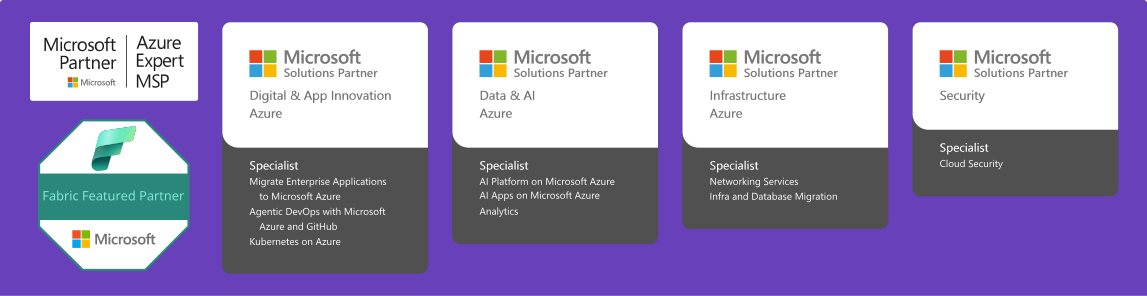

Microsoft Azure Badges

Trusted by the world's leading companies

Frequently Asked Questions

Traditional DevSecOps automation follows predefined rules, scripts, and pipeline gates. Agentic DevSecOps adds AI agents that can interpret context, reason through findings, recommend or trigger approved actions, validate outcomes, and escalate exceptions. WebNetNode defines where agents can act, where humans must approve, and where policies should block action before anything reaches production.

No. Agentic DevSecOps reduces repetitive analysis, coordination, and validation work, but engineers still own policies, risk decisions, production outcomes, and high-impact approvals. Agents help teams move faster by handling repeatable tasks and surfacing better context for human decisions.

Agentic DevSecOps can integrate with repositories, CI/CD systems, security scanners, cloud platforms, observability tools, ticketing systems, infrastructure-as-code tools, and release management workflows. WebNetNode designs integration patterns that allow agents to access only approved tools, pass context between systems, and operate within defined permissions instead of bypassing the delivery stack already in place.

WebNetNode typically begins with an assessment of current delivery workflows, CI/CD maturity, security controls, toolchain integration, compliance needs, and release governance. From there, we define agent suitability, decision boundaries, orchestration architecture, control-plane requirements, and a phased roadmap for implementation.

Timelines depend on the maturity of the pipeline, the number of tools involved, and the risk level of the workflow. A focused first use case, such as vulnerability triage, IaC review, policy validation, or canary analysis, can usually be scoped and piloted before broader rollout. WebNetNode designs the first workflow as a repeatable pattern so future agents can reuse the same controls, integrations, and governance model.

Cost depends on workflow complexity, tool integrations, model usage, infrastructure needs, and how many agentic workflows are moved into production. Costs can rise if agents run without limits or handle low-value tasks. WebNetNode controls this by prioritizing high-impact workflows, selecting fit-for-purpose models, setting usage boundaries, and monitoring agent performance, cost, and business value over time.

Yes, but the design has to be stricter. Regulated environments need clear approval thresholds, evidence capture, access controls, policy enforcement, audit trails, and exception handling before agents can participate in delivery workflows. WebNetNode builds these controls into the operating model so agentic execution supports compliance instead of creating hidden risk.