Agentic SDLC

Reduce cycle time and cost per feature with a governed Agentic SDLC

AI coding assistants accelerate individual tasks but leave delivery economics unchanged. WebNetNode deploys coordinated agent systems with spec-driven foundations, separated evaluators, and governed escalation paths so your SDLC delivers more per cycle with verifiable quality.

I'd Like To Know More!

banner image

Agentic SDLC built for production-grade delivery and governed verification

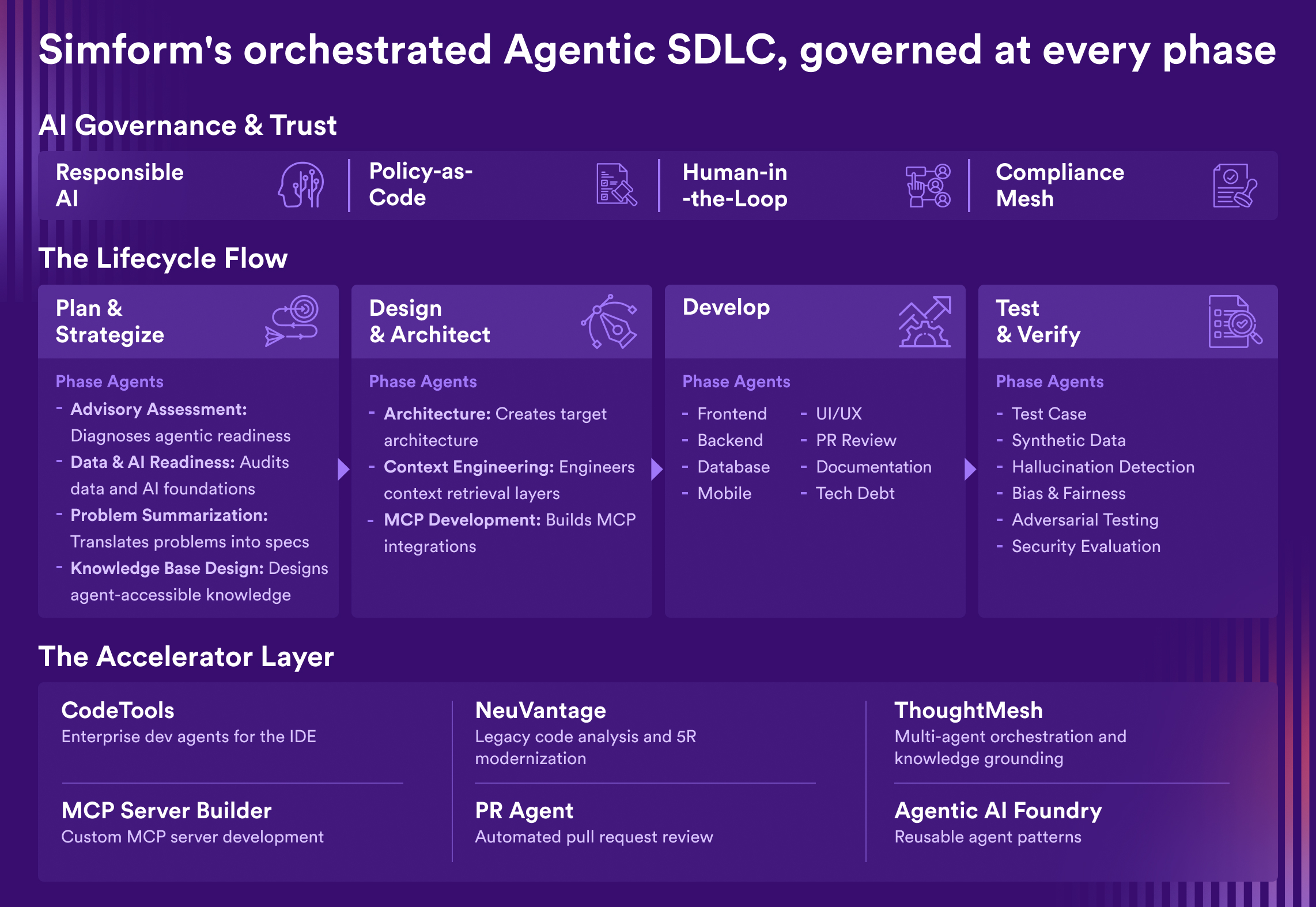
As a Microsoft Solutions Partner for Data & AI, WebNetNode brings the engineering rigor required to run Agentic SDLC inside production codebases — spec-driven foundations, multi-agent coordination, and governed verification. Our accelerators, CodeTools and NeuVantage, compress the path from spec to verified code with reusable patterns for codebase analysis, agent orchestration, and agentic quality verification. Earlier in the journey, our Agentic SDLC Advisory covers readiness assessment, use case prioritization, and an adoption roadmap.

Spec-driven design & context engineering

Agents without precise specifications and grounded context produce inconsistent code that fails review. WebNetNode builds the specification discipline and context architecture that turns requirements into testable contracts and grounds every agent decision in trusted enterprise knowledge.

Specification-driven development foundations and test-driven scaffolding Context and retrieval architecture grounded in enterprise knowledge Model Context Protocol server development for secure tool & data access ThoughtMesh-powered knowledge base and access controls System architecture and design documentation generation
Multi-agent code generation & review

Single-agent copilots fragment workflows and create review fatigue at scale. WebNetNode deploys coordinated dev, review, and remediation agents that preserve context across phases, anchored by CodeTools and Agentic AI Foundry.

Dedicated dev agents across frontend, backend, database, mobile, and UI/UX Multi-agent orchestration with role separation and context propagation across phases Automated code review via PR Agent, plus documentation and tech debt remediation agents Custom enterprise agent development via CodeTools inside the developer IDE Reusable agent reference patterns and scaffolding via Agentic AI Foundry
Agentic quality engineering

Agentic systems generate code faster than human reviewers can validate, and traditional QA cannot keep pace. WebNetNode separates evaluators from generators, runs hallucination, bias, and security checks inside the development cycle, and ties every verification to specification and acceptance criteria.

Independent evaluator models with separated generation and judgment Automated test case generation and synthetic data pipelines Hallucination, bias, and fairness testing on agent-generated output Adversarial AI testing and security evaluation within the development cycle Verification frameworks tied to specification and acceptance criteria
Agentic governance & human oversight

Agentic systems produce non-deterministic outputs that traditional code review alone cannot govern, especially inside regulated environments where every action must be traceable. We implement a responsible AI framework across your SDLC, encode policies as executable controls before agents can generate or merge code, and design human-in-the-loop boundaries with escalation for high-stakes decisions. A compliance mesh layer preserves audit-grade trails for every agent action, enabling traceability in regulated environments.

Responsible AI framework aligned to enterprise policies and regulatory requirements Policy-as-code controls are enforced at the agent runtime layer Human-in-the-loop boundary design with structured escalation paths Compliance mesh for audit-grade traceability across agent actions AI risk management framework spanning the SDLC

Trusted by the World's Leading Companies

Frequently Asked Questions

We verify agent output before a human ever sees it. WebNetNode separates the evaluator models from the generators, so judgment stays independent, and agents cannot grade their own work. Every output is checked against its specification and acceptance criteria, then run through hallucination, security, and adversarial tests inside the development cycle. Spec-driven foundations set testable contracts up front, so reliability is built into how agents work from the start.

WebNetNode runs the agents as one orchestrated system, so context travels with the work across planning, development, review, and release. Specialized dev agents cover frontend, backend, database, mobile, and UI work, with review, documentation, and tech-debt agents alongside your developers. ThoughtMesh coordinates them and grounds each agent in your engineering knowledge. The agents stay connected and carry shared context, so the work holds together across phases.

WebNetNode encodes your policies as executable controls that run at the agent layer. Agents cannot generate or merge code outside the rules you set. High-stakes decisions are routed to humans through defined escalation paths, and a compliance mesh maintains an audit-grade trail of every agent’s action. Your IP stays protected because agents operate securely within your context, without mandatory external source code uploads.

For modernization, WebNetNode points the agents at your legacy codebase first. They map dependencies and business logic and produce validated specifications and target architectures. NeuVantage drives the legacy analysis and 5R modernization paths, so the plan rests on a real reading of your systems. The same agents then generate and verify the modernized code against those specs, for a rebuild, a data warehouse migration, or system consolidation.

WebNetNode builds the agents to operate inside your existing stack. Model Context Protocol layers securely connect them to your tools, repositories, and data, so they work in your real environment. CodeTools runs in VS Code alongside assistants like GitHub Copilot, adding context-aware agents for review, documentation, and infrastructure work. The agents fit your current pipelines and review gates, so your team keeps shipping the way it already does.

A delivery engagement runs as one orchestrated multi-agent system across plan, design, develop, and verify, governed at every step. If you have done the advisory, we start from your readiness baseline, prioritized use cases, and roadmap, so the sequence is already set. If you have not, we will scope the first phase with you before agents take ownership. Our accelerators compress each phase with reusable patterns, turning your specifications into verified, production-grade code.